Synthesit and chemotherapy for oral cancer: what did one clinical case show?
The scientific article we are reviewing describes a rather rare situation - an attempt to support a patient's blood during severe chemotherapy with iron supplementation Synthesit (a proprietary form of iron in the form of ferricitrate) in a woman with stage III oral cancer.
The authors do not prove that the drug works wonders, but they accurately show that against the background of its administration, it was possible to slightly improve red blood counts and continue treatment. Let's take a step-by-step look at exactly what happened and how to treat it.
Oral cancer is an aggressive tumor, most often squamous cell carcinoma. More than 90% of the tumors in this area belong to this type, and hundreds of thousands of new cases are diagnosed worldwide every year.
Stage III is characterized by:
Standard treatment usually includes:

Chemotherapy affects not only the tumor, but also the bone marrow, the "blood factory." This leads to:
Hence, weakness, fatigue, the risk of infections and bleeding, and sometimes the need to postpone or cancel courses of chemotherapy.
To combat this, use:
But even with this, many patients have moderate improvements and chemotherapy has to be adjusted.
Synthesit is a dietary supplement containing iron in the form of ferric iron (III) citrate (ferric iron III citrate). The authors of the article describe it as:
According to the data they cite:
Important: so far, these are mostly either preclinical data or isolated clinical cases, rather than large randomized trials.
Patient M., 53 years old, stage III oral cancer (T3N2M0), with lymph node involvement. She received CF (cisplatin + 5-fluorouracil) chemotherapy in France.
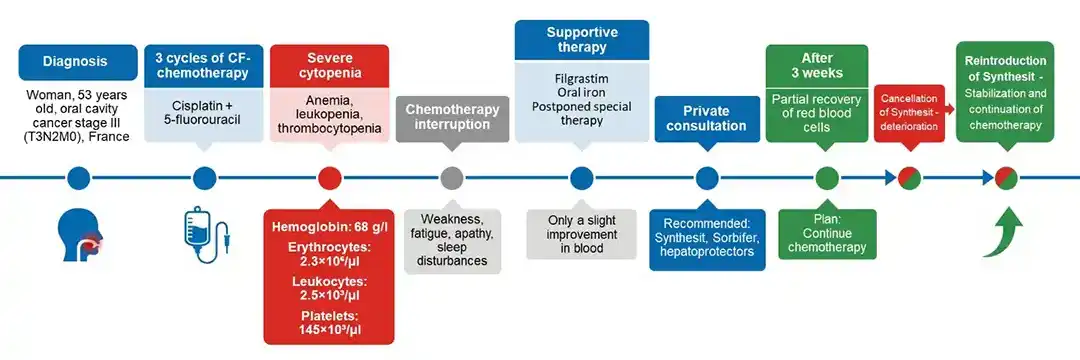
After three courses, she developed:
Symptoms:
Blood tests at this point showed severe inhibition of hematopoiesis:
Against this background, the chemotherapy had to be interrupted. The patient was prescribed:
However, blood recovery was weak, and his health remained poor.
Later, the patient came to a private consultation, where she was assigned:
And they recommended retaking the tests in three weeks.
This is not an experiment with a control group, but a description of a single case.
Below is Table 1 with the dynamics of the main blood parameters for the period from October 2024 to May 2025, and below it is a graph (Fig. 1), which shows a gradual change in these parameters over time.

Threekey points can be traced according to Table 1: On 10/21/2024, 01/06/2025 and05/14/2025.
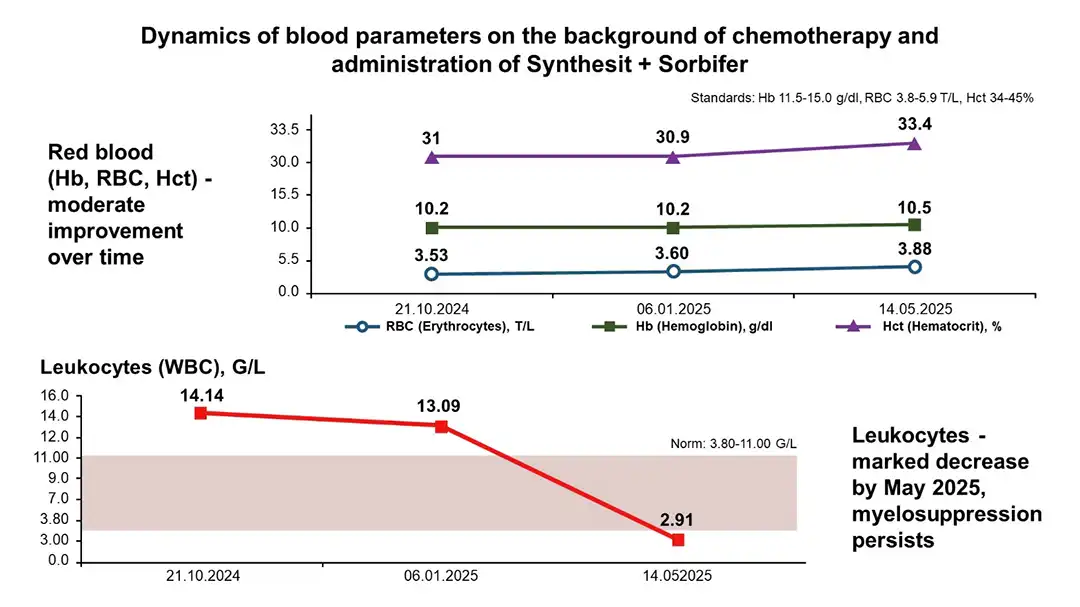
The normal values for women according to the table are RBC 3.8-5.9 T/L, Hb 11.5-15 g/dl. That is, the patient remained in the zone of moderate anemia, but the curves crept up, not down, which is not bad for ongoing chemotherapy.
Figure 1 on the same page shows that:
This does not indicate a miraculous recovery, but a partial restoration of erythropoiesis (the formation of red cells) after the connection of iron, including Synthesit.
In the same place, in Table 1, it is clearly seen that the situation with white blood is the opposite.
The detailed blood formula is given in Table 2:
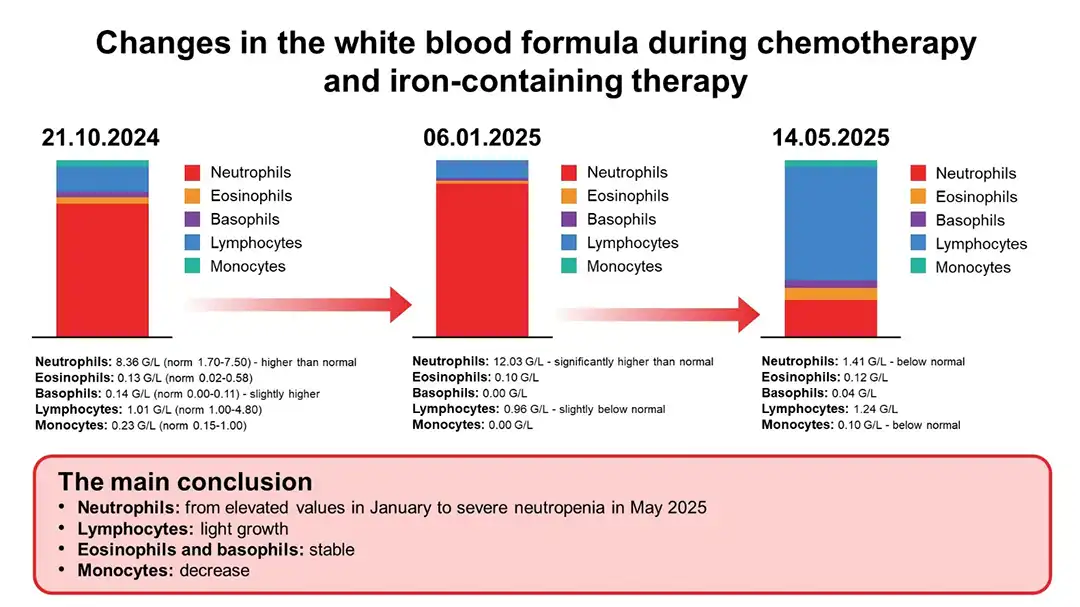
In the figure, this can be seen as a sharp "drop" in the neutrophil line by May 2025.
The authors interpret it this way:
According to the doctors' description:
But it is important to remember: these are subjective sensations + one clinical case, without a control group and "blindness".
Table 1A. Analysis of proteins of blood plasma done in December 2019. Parameters that were out of the reference range are highlighted.
Table 1B. Blood analysis before taking Synthesit in February 2020, during taking in July 2021 and after taking it in March 2023. Parameters that were out of the reference range are highlighted. Values marked as dash mean no data available.
Figure 1. Comparison of various hematological parameters.

Table 2. Analysis of proteins of blood plasma done in March 2023.
The authors provide a short literature review on the topic of iron and Synthesit:
At the same time, the authors recall major work on intravenous iron:
Againstthis background, the authors consider Synthesit as potentially:
The authors honestly list what is missing from this study:
It is not yet possible to conclude from this article that "all cancer patients urgently need Synthesit." But you can formulate a few neat theses.
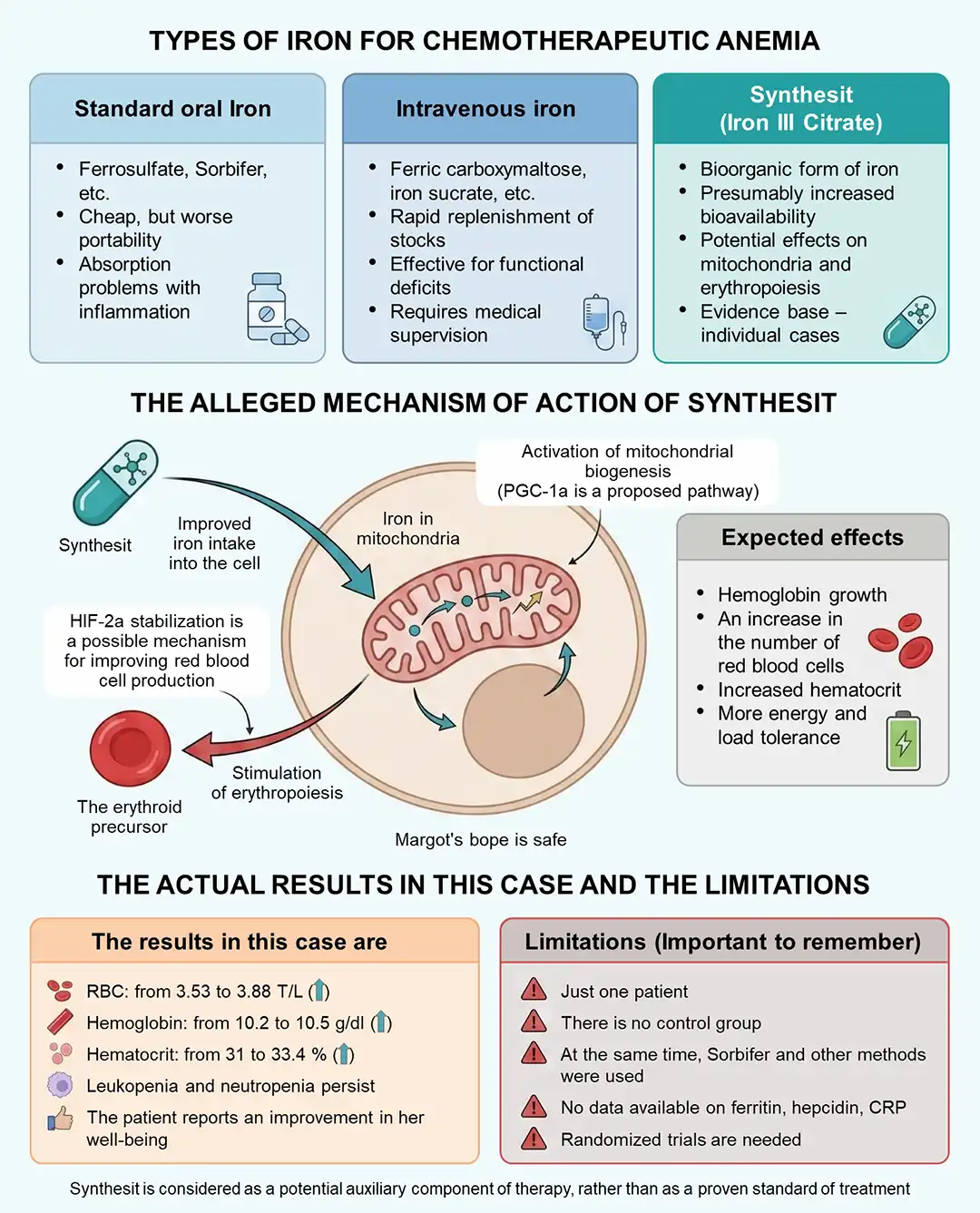
The article describes a woman with stage III oral cancer, in whom chemotherapy caused severe anemia and hematopoiesis suppression. After connecting Synthesit together with the usual iron preparation Sorbifer, the red blood counts improved slightly, my health improved, and I was able to continue chemotherapy. At the same time, the immune system remained suppressed, especially along the neutrophil line.
In this case, Synthesit looks like a possible auxiliary player in the treatment of anemia on the background of chemotherapy, but far from being a fully proven standard. To talk about it seriously as part of the oncological protocol, large and rigorous studies are needed, but for now its use is rather an experimental and individual story that must be discussed with the attending oncologist and hematologist.
Original article: